
1
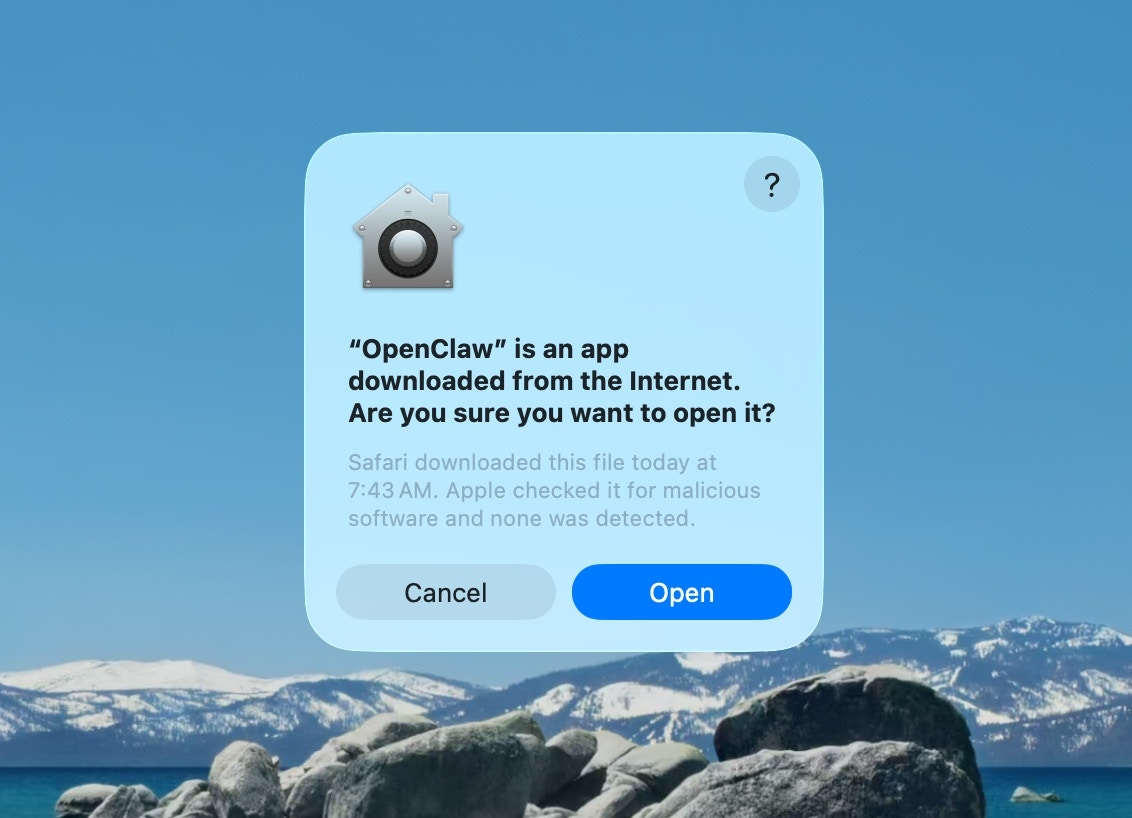
Approve macOS warning
2
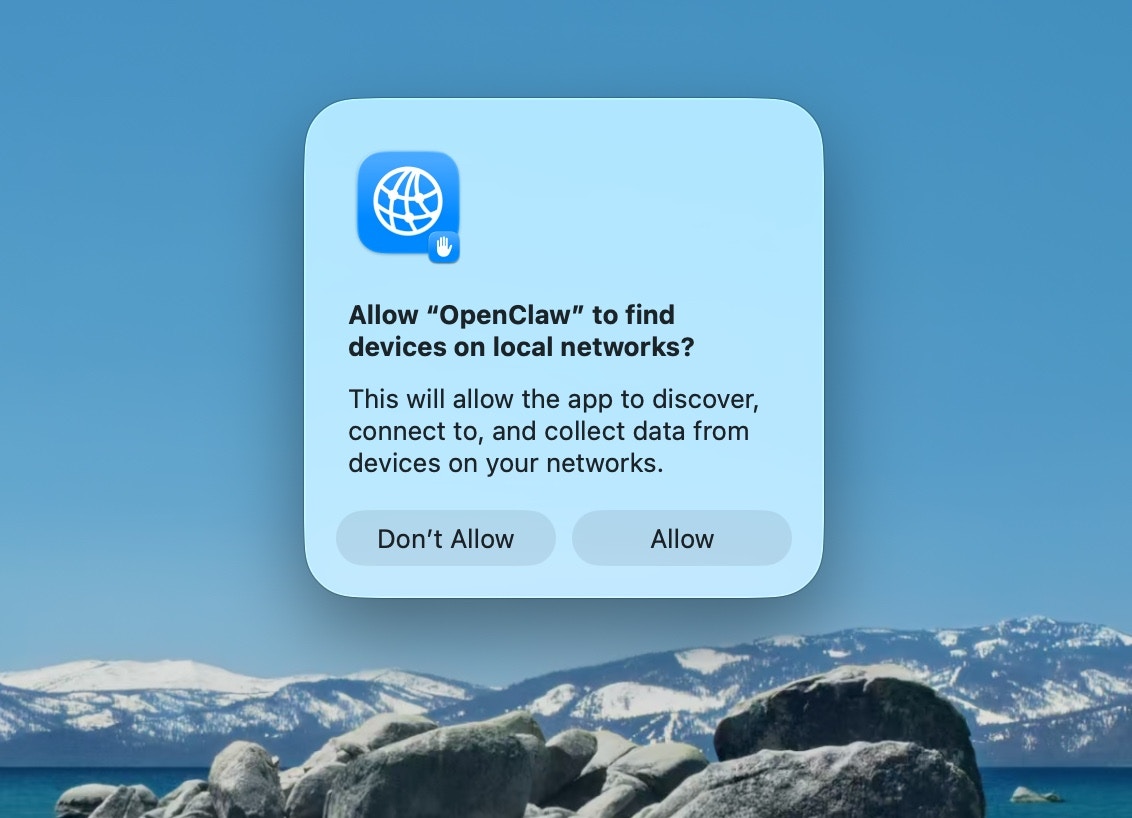
Approve find local networks
3
Welcome and security notice
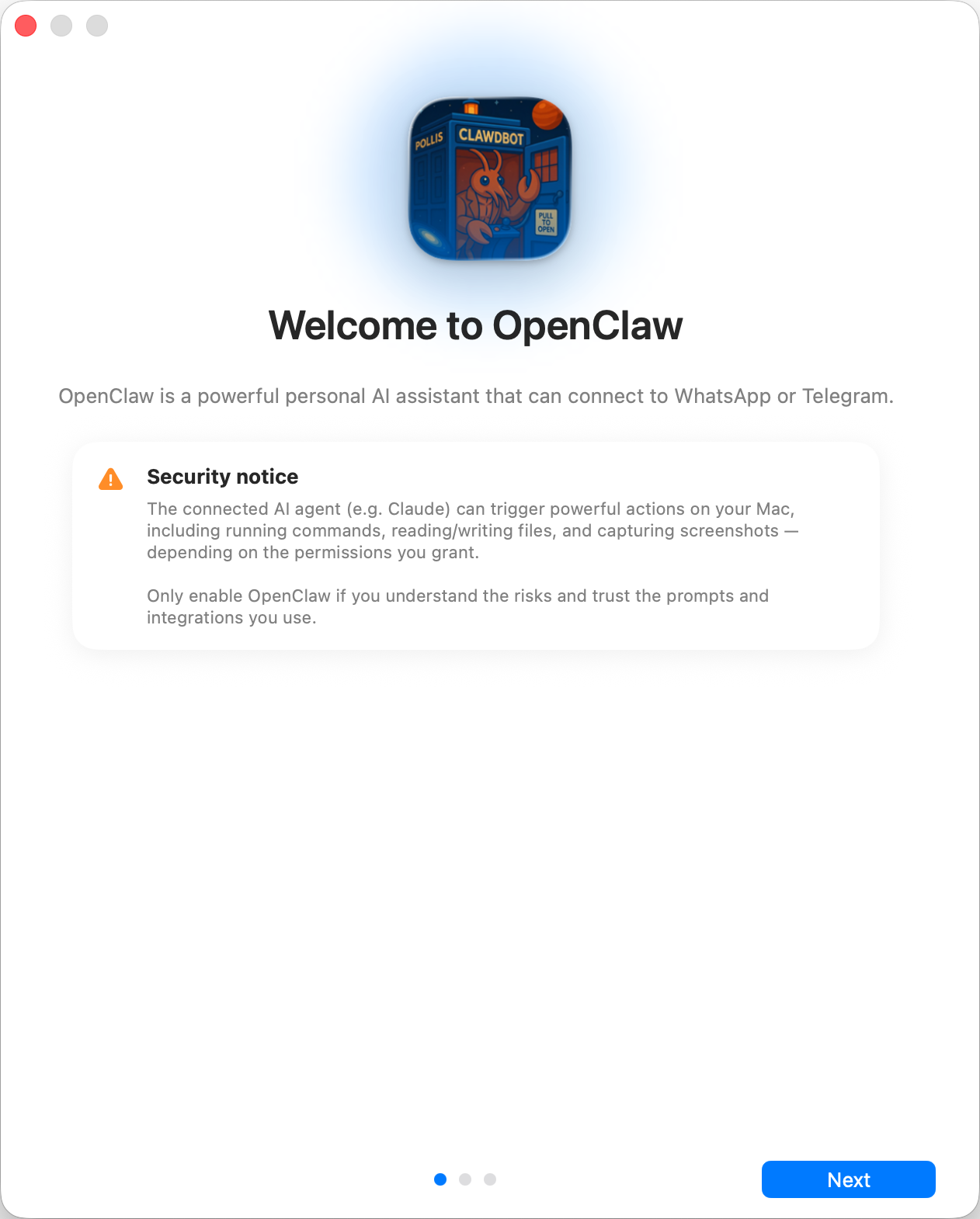
Read the security notice displayed and decide accordingly
- By default, OpenClaw is a personal agent: one trusted operator boundary.
- Shared/multi-user setups need lock-down: split trust boundaries, keep tool access minimal, and follow Security.
- Local onboarding defaults new configs to
tools.profile: "coding"so fresh setups keep filesystem/runtime tools without the unrestrictedfullprofile. - If hooks/webhooks or other untrusted content feeds are enabled, use a strong modern model tier and keep strict tool policy/sandboxing.
4
Local vs Remote
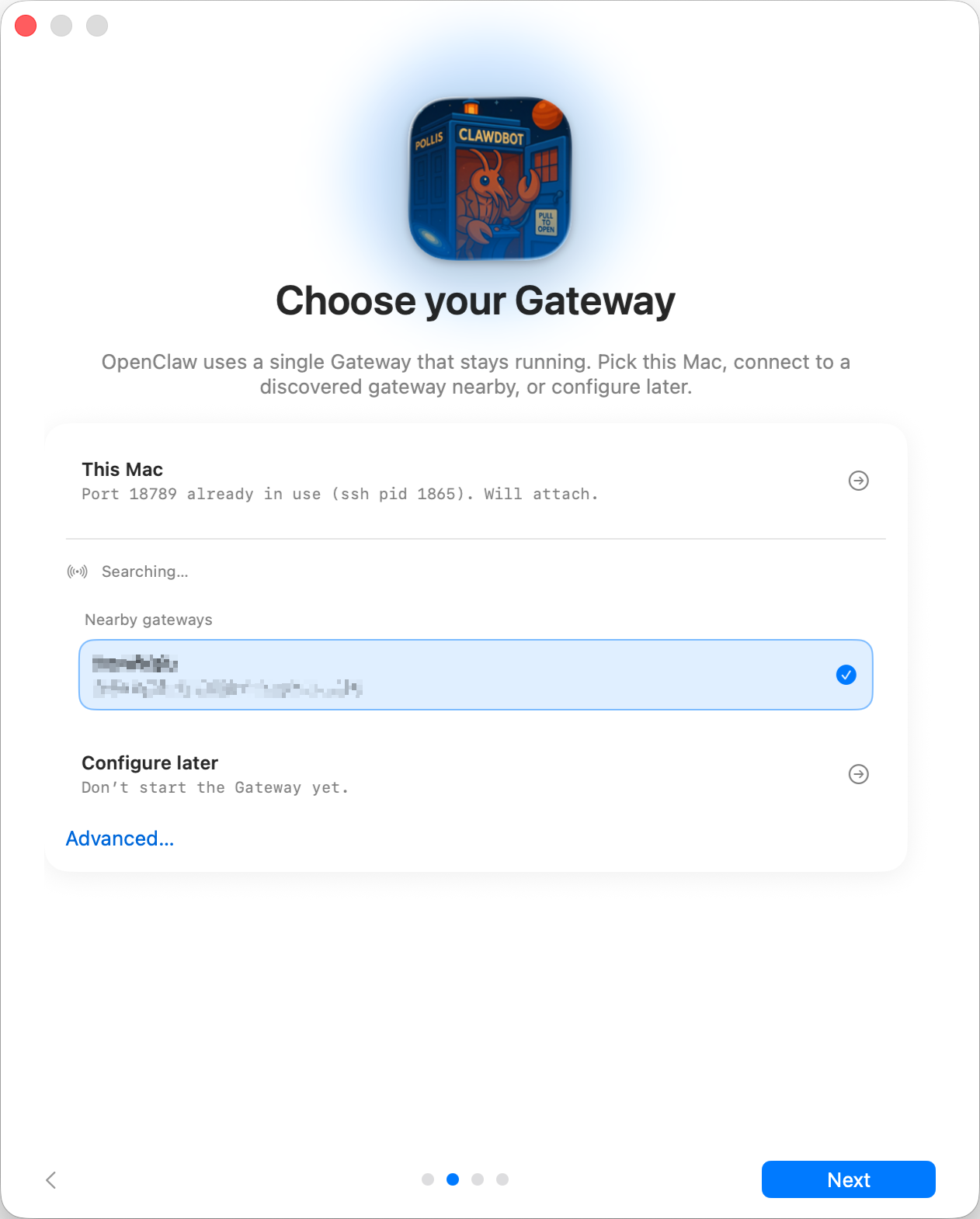
- This Mac (Local only): onboarding configures auth and writes credentials locally.
- Remote (over SSH/Tailnet): onboarding does not configure local auth;
credentials must already exist on the gateway host. The remote gateway token
field stores the token the macOS app uses to connect to that Gateway;
existing
gateway.remote.tokenSecretRef values are preserved until you replace them. - Configure later: skip setup and leave the app unconfigured.
5
CLI
Local setup installs the global
openclaw CLI via npm, pnpm, or bun,
preferring npm first. Node remains the recommended runtime for the Gateway
itself. Existing compatible installations are reused.6
Connect your AI
A connected Gateway that already has a configured agent model skips this
page entirely and opens the normal agent UI. OpenClaw and provider setup
only run for a fresh or incomplete Gateway.Once the Gateway is ready, onboarding looks for AI access you already have:
a Claude Code or Codex login,
OPENAI_API_KEY / ANTHROPIC_API_KEY, or a
tool-capable model with at least 16K of measured effective context already
installed in a reachable Ollama or LM Studio server. Detection runs on the
Gateway host, including when the macOS app connects to a Linux Gateway. The best
option is tested with a real completion and only saved
after it answers; when a test fails the app automatically tries the next option
and shows why the previous one failed. If several options are found you can
switch between them before continuing. Automatic local discovery never pulls
or downloads a model.To use a Claude subscription when the Gateway host has no Claude CLI login, run
claude setup-token on any machine with Claude Code installed, then paste the
printed token as Anthropic setup-token under Connect with an API key or
token.Pi and OpenCode installs may be shown for context when they cannot be selected
as the reusable guided-setup inference route. They are whole-agent harnesses,
not setup inference routes; their session integrations require separate runtime
and plugin setup. Gemini CLI and Antigravity are not offered as detected setup
routes.You can also sign in through the provider’s own OAuth or device-pairing flow.
The built-in choices include OpenAI/ChatGPT, OpenRouter, GitHub Copilot, xAI,
MiniMax Global and CN, and Chutes. Google is available through the supported AI
Studio API-key route. The list comes from the
Gateway’s active text-inference provider plugins rather than a fixed app list,
so another provider can opt in without adding provider-specific macOS code.The manual key/token picker uses the same provider registry. In every route,
the provider supplies its starter model and configuration; OpenClaw verifies
the credential with the same live test before storing its auth profile. Next
remains locked until one backend has passed, so the first agent chat cannot
start without working inference. After that live check passes, OpenClaw becomes
available to help configure the remaining workspace, Gateway, channels, and
other optional features. When OpenClaw offers a short list of choices, the app
shows native option cards; choosing one sends the selection, and Skip for
now always leaves the choice optional. OpenClaw is also available later under
Settings → OpenClaw.7
Import memories (shown when detected)
For a local Gateway, onboarding checks the Mac for memories from supported AI
tools: Claude Code auto-memory, Codex consolidated memories, and Hermes memory
files. When any are found, this page lists each source with its memory count
and lets you import the selected sources into the agent workspace under
memory/imports/ for indexed recall. Already-imported files are skipped, and
the page never appears when there is nothing to import. Skipping is safe; the
dashboard’s Memory import page offers the same import later with per-file
control.8
Permissions
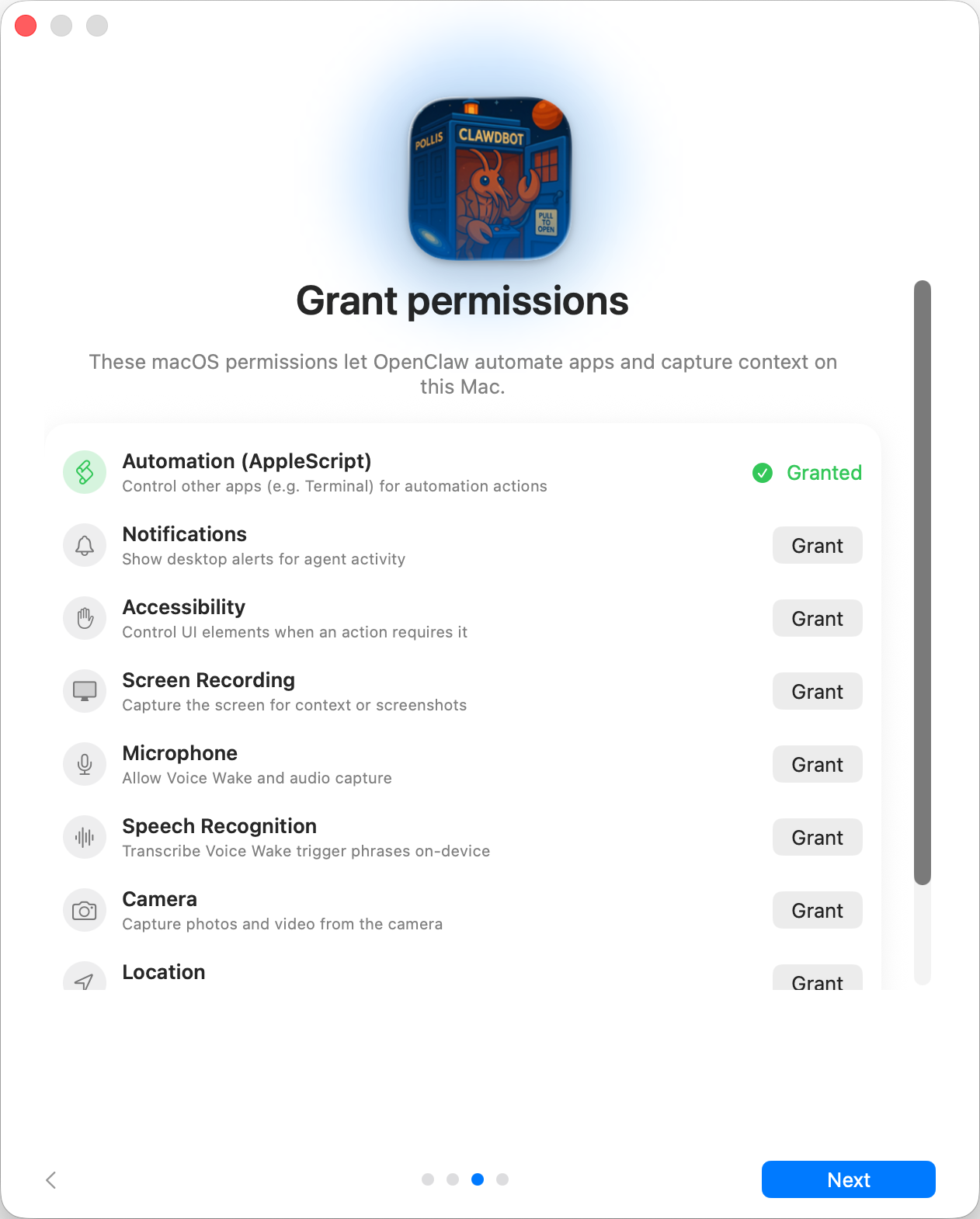
Choose what permissions do you want to give OpenClaw
9
Finish
After inference passes, OpenClaw owns the remaining optional setup and can
hand you off to the normal agent chat. Finishing the permission walkthrough
opens that same chat; the app does not create a workspace or launch a separate
agent setup conversation before OpenClaw. See
Bootstrapping for what happens on the gateway host
during the agent’s first real turn.